How Turkish Diaspore Changes Colour
Turkish diaspore changes colour because trace elements in the crystal absorb light selectively: in daylight (rich in blue-green wavelengths) it reads olive to kiwi green, and under incandescent or candlelight (rich in red-orange wavelengths) it shifts to champagne, gold or…
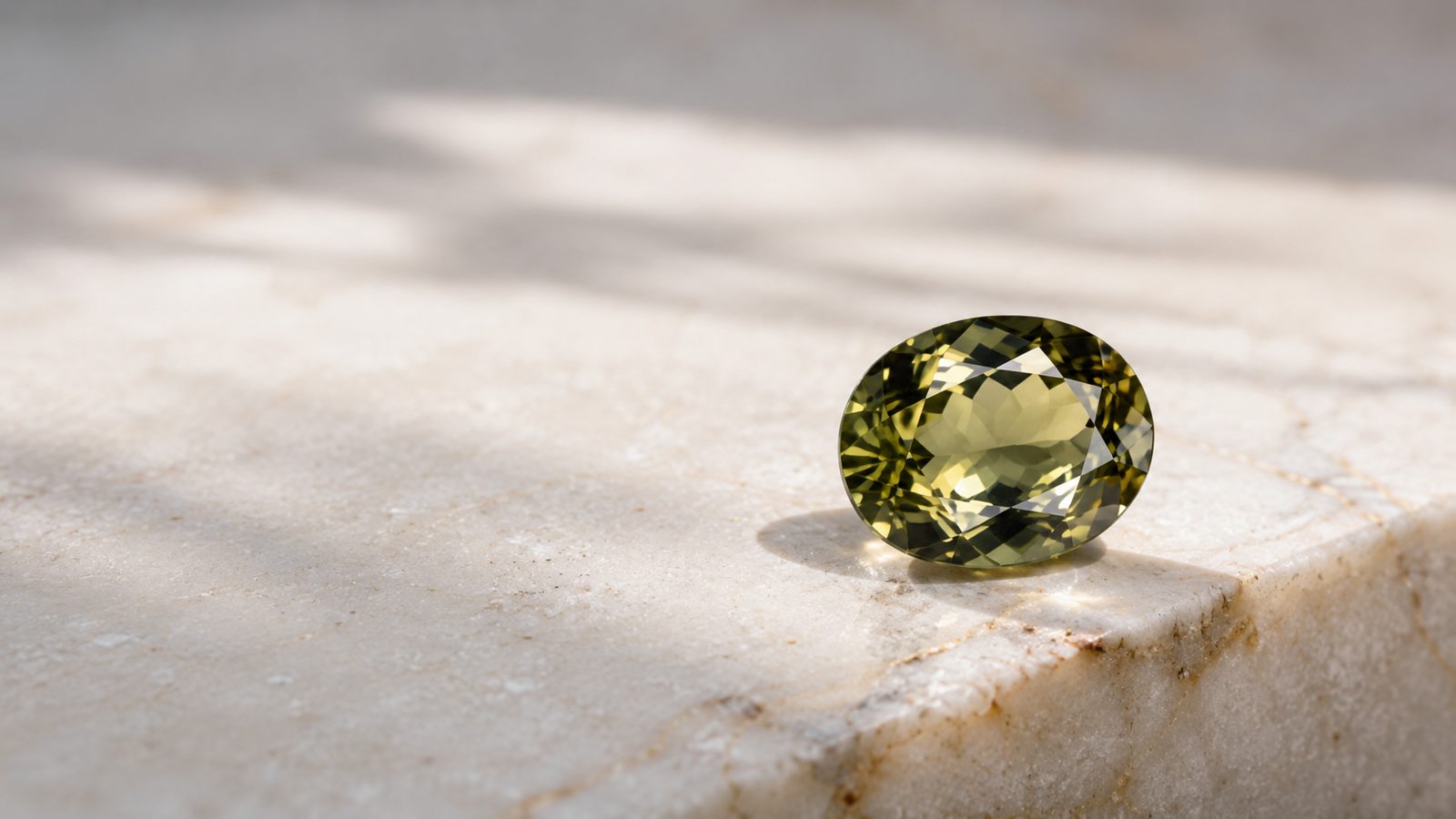
The defining feature of gem-quality Turkish diaspore — the material sold in the trade as Zultanite, Csarite, Ottomanite and Turkizite — is a distinct, natural colour-change. The same stone can look olive to kiwi green in daylight and warm champagne, gold or raspberry-pink under candlelight. Understanding why this happens is the clearest way to appreciate the gem.
What colour-change means
Colour-change is a real, reversible shift in a gem’s body colour when the light source changes. It is the same optical phenomenon known as the alexandrite effect, named for the chrysoberyl variety in which it was first catalogued. In diaspore the effect is usually strong and easy to see with the naked eye, which makes it one of the species’ most distinctive identifying features.
Why daylight and candlelight look different
Daylight and fluorescent light are rich in blue and green wavelengths; incandescent bulbs and candlelight are rich in red and orange wavelengths. The diaspore crystal absorbs some wavelengths more strongly than others, so the colour you perceive depends on which wavelengths the light source provides. Under cool, blue-rich light the green transmission dominates; under warm, red-rich light the pink-to-champagne transmission dominates.
The role of trace elements
Pure diaspore is an aluminium oxide-hydroxide, AlO(OH), and is colourless. Turkish diaspore owes its colour to small amounts of trace elements — chiefly manganese with iron — sitting in the crystal structure. These trace elements are responsible for the selective absorption that produces the two-light behaviour. The colour is intrinsic to the crystal, not added.
How to observe it correctly
To judge colour-change fairly, view the stone under two clearly different light sources: natural daylight (near a window, not in direct sun) and a warm incandescent bulb or candle. Give your eyes a moment to adapt to each source. The shift is gradual and continuous, not a sudden switch, and its strength varies from stone to stone.
Is it natural?
Yes. In Turkish diaspore the colour-change is entirely natural and needs no heat, irradiation or coating. Colour-change glass imitations do exist, so the reliable check is an independent gemological report that identifies the species as diaspore with natural, untreated colour change.
Sources & Further Reading
Have a question about Turkish diaspore?
We’re here to help you learn more about the stone, not to sell it.